
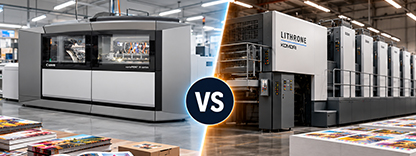
Commercial Inkjet Printing versus Traditional Litho – the reality as we experience it here at Remata
For decades, offset litho was the undisputed standard for quality print. Its fine screen rulings, flat solids, and colour made it the benchmark every other process was judged against. Commercial inkjet has spent years chasing that benchmark. We feel that benchmark has been met and perhaps even exceeded.
Quality and consistency
Modern true production inkjet presses, like Remata’s Canon’s varioPRINT IX commercial press, now run at effective resolutions that uses multi-drop heads and finer native screening to produce results that are very difficult to distinguish from litho. Inkjets stochastic screen ruling can produce incredible fine detail, beautiful images, smooth gradients of colour and a wider color gamut than its rival, litho, can sometimes produce.
Where inkjet genuinely pulls ahead is consistency. A litho press drifts — ink/water balance shifts, plates wear, and colour has to be actively managed sheet to sheet. Inkjet doesn’t have that variable. Sheet one and sheet ten thousand come out identical, because the same fixed digital file drives every impression. For brand work where colour accuracy across a run is non-negotiable, that repeatability is a real competitive advantage.
Makeready and cost on shorter runs
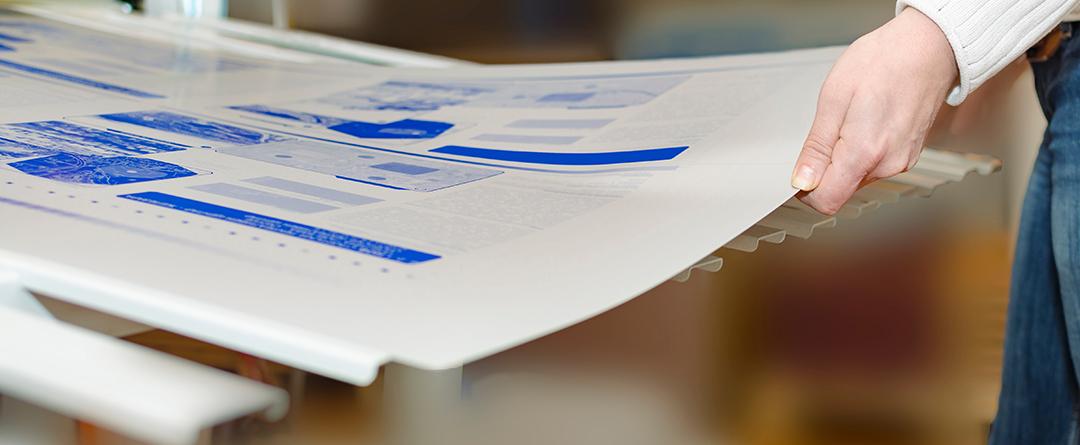
This is where the comparison stops being close. Litho makeready — plates, wash-ups, colour tweaking can consume 30 minutes to an hour and a significant volume of waste sheets before the first good sheet runs. Inkjet has none of that. Job one prints as cleanly as job one thousand, with effectively zero setup waste and setup time measured in minutes, not passes.
That difference dictates where each technology wins on cost. On short-to-medium runs, inkjet’s near-zero makeready overhead outweighs litho’s lower per-sheet ink cost. On long runs, litho’s economics still win — the fixed setup cost gets amortised over enough sheets that its lower running cost pulls ahead. The crossover point keeps moving in inkjet’s favour as head technology and ink costs improve, but it hasn’t disappeared.
Coverage: the real deciding factor
Run length isn’t the only variable — coverage is often the one that actually decides whether a job can move to inkjet at all. Heavy solids, large flat colour areas, and saturated coverage put more strain on inkjet’s ink laydown and drying than litho, which handles solid coverage natively through its ink film. A job with light-to-moderate coverage (typical brochures, books, variable data pieces) are usually a clean fit for inkjet. A job dominated by heavy solids or deep spot-colour panels may still need litho’s ink density and consistency to hold up, or need substrate and workflow adjustments before it can move across.
The shift is underway
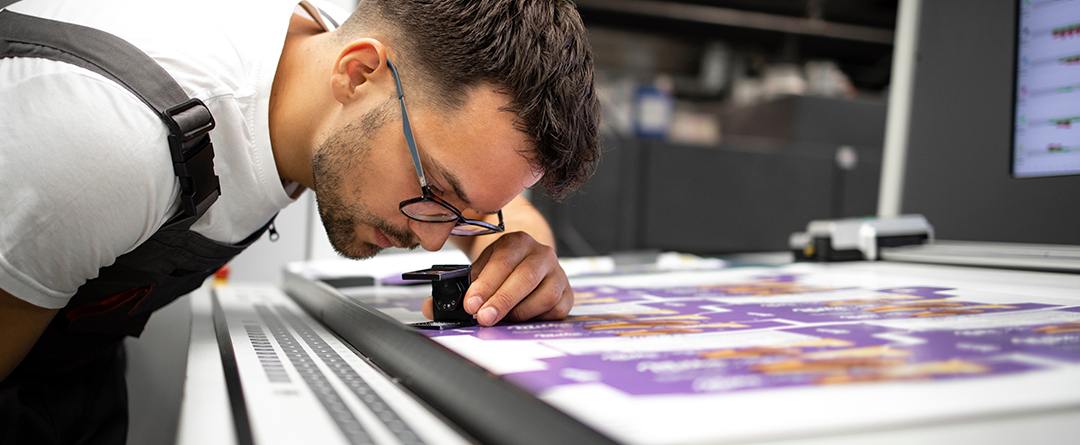
None of this means litho is being replaced outright — it means the decision of which press a job runs on has become genuinely technical rather than automatic. Screen ruling requirements, run length, coverage, and turnaround now get weighed against each other on a job-by-job basis, in a way they didn’t when litho was simply the only serious option. This opens print production to more options that provide true high end quality using the technology best suited for the print project.
What’s changed is that inkjet is no longer the compromise choice for jobs too short or too urgent for litho. On the right job, it can now offer superior colour accuracy and detail, tighter consistency, and a straight line from file to finished, folded, stitched product with none of the setup lag litho carries.
Litho remains the stronger tool for long runs and heavy coverage. But for the first time, litho has a direct competitor that can outperform it, not just substitute for it, on the jobs where speed and consistency matter most.
Remata offers the perfect blend of Litho, Inkjet and other digital printing devices so contact us today for a quote or to speak to one of our print specialists.